Mineral resource
 Implats Annual

“The Group achieved a
number of new safety
milestones and record
performances during
the year
The Group achieved a number of new safety milestones and record performances during the year and excellent progress was made in implementing new safety technology and training however, these achievements were overshadowed by the seven fatal incidents involving our employees and contractors that occurred during this year.
Four of the seven fatalities occurred immediately following the five-month strike at Impala Rustenburg. Prior to this, the Group had achieved an all-time record of 6.9 million shifts without a fatal incident.
Details of the fatalities and of the Group’s safety performances are contained in this report. (see here and .)
Ensuring the safety and health of our employees, contractors and suppliers is essential if we are to respect their most fundamental human rights; without a meaningful commitment to respecting the rights of those with whom we interact, we will have no social or political licence to operate.
Significant improvements are evident across almost all of our leading and lagging performance indicators. Our improvements in safety performance have been underpinned by the effective implementation of the safety recognition agreement with AMCU. Completed in November 2013 after a three-month negotiation process, the agreement lays out the agreed responsibilities for management and union representatives on safety issues.
Developments during the year
Following is an overview of the progress made during the year on some of the key strategic initiatives under each of the three pillars of our safety strategy.
Person
Culture
- A core goal of our safety strategy is to drive a change in the safety culture across the Group, from the traditional measured culture of dependence to independence, and ultimately to interdependence. In our dependent culture, although there is an acceptance of the need for safe practices, these are generally only followed when effective supervision is present and demands it. In an independent culture, every employee is committed to safe working practices, taking clear responsibility for their own actions. In the interdependent culture that we are striving for, there is the added focus of helping others to adopt good safety practice.
- We have continued in our efforts to implement the five-pillar cultural transformation framework developed by the Mine Health and Safety Council (MHSC), and have taken further steps to embed the Mining Charter’s health and safety commitments. The new milestones are outlined here.
Effective leadership
- The CEO, with the support of the executive team, is driving our overarching objective of developing the right safety culture through effective leadership and by demonstrating visible personal commitment. This strong executive commitment is evidenced by the measures taken early in the year following the five fatal injuries that occurred shortly after the return to work after the five-month strike. In response to the increase in incidents the Implats CEO and members of the Implats’ executive relocated to Impala Rustenburg for two weeks to assess and review our safety plans. A revised business plan was developed with input from internal and external sources. An important aspect of the new plan is a focus on safe behaviour and compliance to standards and, where wilful deviations occur, the enforcement of discipline.
- Implats’ executives and all E and D level production managers have attended the Zero Incident Process (ZIP) for Leaders training programme. The programme, presented by Australia’s Sentis Group, provides managers with insight into the human behavioural aspects of safety and how to influence this in order to achieve improved safety awareness and performance in their subordinates.
- Safety-related issues also form a key component of the five-day supervisory leadership training course that provides for managers, mine overseers, engineers and services managers. This year, 57 employees participated in the three-day people leadership programme.
Motivation
- A new zero-harm incentive scheme which divides the incentive equally between safety and production has been implemented. The safety component comprises the leading requirement that nets and bolts be installed on all panels and development ends, as well as the lagging measure of workforce lost-time injuries. The long-term incentive scheme for D and E levels also includes the lagging FIFR three-year performance compared with industry peers. The short-term incentive scheme for E level management has been increased to 35%, with a component of lead indicators.
Team mobilisation
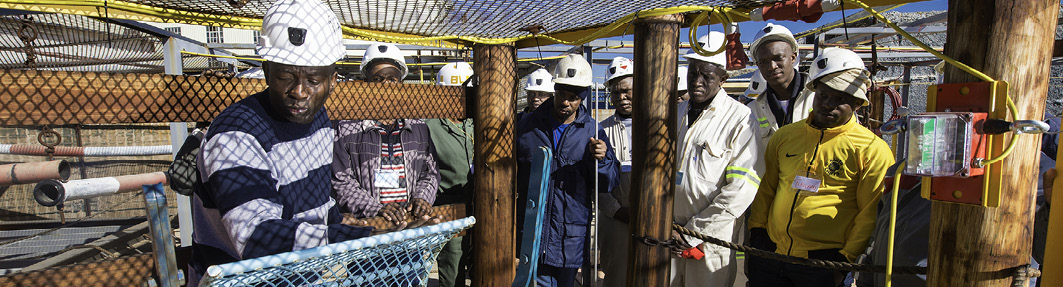
- This year 139 (23%) of the 600 targeted teams underwent our five day team-mobilisation training programme aimed at enhancing team functionality among our underground stoping teams. Team mobilisation includes a strong safety focus whereby teams are trained in the importance of safe production.
Practices
Risk management system
- A third-party review of our baseline risk assessment was completed this year. Appropriate steps are being taken to address the key findings from the review. An online hazard identification and rectification system has been implemented across the Group, providing ready access to the required controls and procedures associated with the 14 identified major hazards across our operations. We are currently finalising the process of refining the critical controls for these major hazards.
Triggered Action Response Plan (TARP)
- TARP is a formalised process that enhances the identification of hazards and ensures that these are documented by the team. TARP then requires the formal implementation of appropriate and predetermined action and response measures. During the year, training was provided to all teams on all shafts on TARP which is currently focused on the recognition and response to ground conditions.
Women in Mining (WiM)
- Our WiM task team meets monthly to identify and resolve safety and health issues specific to women. We have been trialling personal protective equipment (PPE) for women, to measure its effectiveness and comfort, and we have implemented awareness initiatives aimed at improving the safety and security of women working underground.
Occupational Health and Safety Assessment Series (OHSAS) 18001
- Independent consultants have completed a detailed gap analysis of our occupational health and safety systems at Impala to identify potential compliance gaps with OHSAS 18001. To meet our goal of full compliance with OHSAS 18001 within three years, our 2016 safety and health business plan will include a specific focus on addressing the findings of the gap analysis.
Critical safe behaviours
- In collaboration with our HSE representatives, we have identified a set of ‘critical safe behaviours’ for 13 critical mining occupations and nine critical occupations at our processing division. With our branch safety representatives we are developing a training and awareness programme, and measurement system, aimed at encouraging the right behaviours needed to keep one safe.
Section 23 actions
- Section 23 of the Mine Health and Safety Act empowers employees to leave their workplace if it appears that there is a serious danger to their health and safety.
Accident investigations have revealed that this does not always occur, even when employees have identified possible danger. During the year, all employees were retrained on these rights and on the formal process which must take place in order to report the danger and to ensure that it has been addressed.