Integrated
 Mineral resource
 Sustainable
 Implats Annual

Management Processes
Risk management

“Implats aims to achieve
a balance between
minimising the risk and
maximising the reward

We identify our strategic business objectives, and our material sustainability focus areas, through our structured internal risk management process, and with consideration to the views and interests of our stakeholders. The Implats risk management process is wholly aligned with ISO 31000, the international risk management standard.
Our risk assessment and management process
Implats’ risk management process sets out to achieve an appropriate balance between minimising the risks associated with any business activity and maximising the potential reward. Effective risk management enables management to deal with uncertainty and associated threats and opportunities, enhancing the enterprises capacity to build value. The most important purpose of enterprise risk management is to institutionalise an ongoing and rigorous identification of risks in all aspects of the business, encourage open and honest dialogue about these risks and bring about the implementation of the necessary controls and risk treatment initiatives. In summary, effective enterprise risk management reduces uncertainty, imbues confidence and enables the organisation to be more decisive in pursuit of our Vision, Mission and Goals. Implats utilises the same, consistent risk methodology for every type of impact across the business as we believe separate risk methodologies would not support the object of embedding and maintaining an intelligent risk culture.
This process enables the board and senior managers to take decisions regarding the possible trade-off between risk and reward, and assists them to identify and pursue appropriate strategic growth opportunities informed by the Group’s risk appetite and risk tolerance levels.
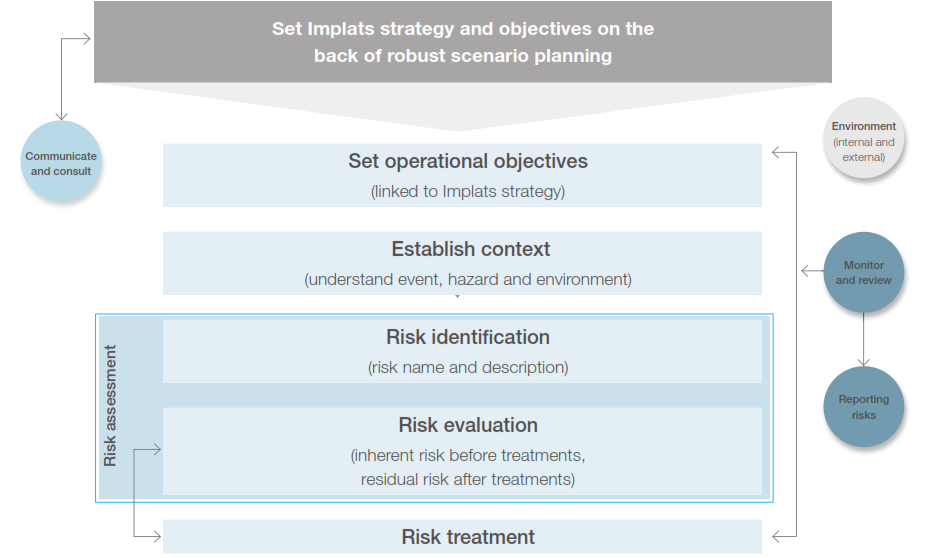
Our risk management process comprises the following steps and is illustrated below:
- Establishing the context: We consider the nature of the external operating context, and the views and interests of our stakeholders
- Identifying the risk: We establish both the source and cause of the risk, and evaluate all possible consequences
- Analysing the risk: We identify and assess what this means for the achievement of our objectives
- Evaluating the risk: We determine the risk rating (by severity, exposure and frequency), identify the controls (both existing or new), and prioritise the risks
- Treating the risk: We consider all options to establish the most appropriate response for each identified risk
Arising from this process we identify a set of objective-based risk assessments (ORAs) that cover approximately 80 of the most important aspects of the Implats business. Each identified risk, as well as its associated controls, has a clearly defined line management owner. This process is repeated and reviewed regularly, ensuring that the information remains relevant. All information is captured into the Group risk repository system that informs the Group risk profile. The Group risk profile is presented on a monthly basis to the Exco and quarterly to the board risk committee, which is separate from the audit committee. This approach allows for robust discussion regarding the materiality of the risk, its likely impact on the business in the short, medium and long term, and the necessary risk mitigation measures.
This process culminates in the identification of a prioritised set of Group strategic risks. Collectively, these risks, along with the outcomes of our internal and external stakeholder engagement activities, and our assessment of market fundamentals, are used to identify our material sustainability-related issues. These issues are prioritised in terms of their impact both on the organisation and on our key stakeholders. They inform the nature of our Group strategic objectives, as well as the performance issues for monitoring and reporting material sustainability focus areas, through our structured internal risk management process, and with consideration to the views and interests of our stakeholders.