
 Integrated
 Mineral resource
 Sustainable
 Implats Annual

Business Model
Operational review - Impala
“The focus is on creating
a more concentrated
mining operation with
access to new, modern
shaft complexes making
better use of the invested
fixed cost base, with
higher mining
efficiencies and lower
unit costs
The ramp-up at Rustenburg following the five-month strike in the previous financial year progressed well, but was interrupted by four fatal accidents and subsequent work and safety stoppages. Full production rates were achieved in November 2014.
Manufactured capital
Safety performance
Impala’s safety performance improved over the year and the total injury frequency rate improved to 10.37 per million man-hours worked (2014: 13.03). Several significant achievements were recorded during the period:
- Refineries and Services both achieved 10 million fatality-free shifts
- 12 and 7A shafts recorded 5 million fatality-free shifts
- 9, 14 and 20 shafts and Rustenburg Processing all reached 1 million fatality-free shifts
- Refineries have recorded a year without a lost-time injury
Despite the overall improvement, six employees suffered fatal injuries during the year. Of these, four occurred in August and September 2014 during the ramp-up of the Rustenburg operation. Following consultations, safety plans were amended to include, among others, the implementation of a critical safe behaviours initiative. This programme culminated in a three-day safety summit which was attended by 600 safety representatives, including employees, union leaders and representatives from the Department of Mineral Resources (DMR), in a collaborative effort to improve safety at this operation. This will remain an ongoing initiative.
Management continues to focus on cultural transformation supported by effective leadership and supervision, compliance with leading safety practices and creating a safe working environment. Team mobilisation has been identified as a key element in ensuring the safe behaviour of employees, with the objectives of enhancing trust, building commitment and accountability, and achieving collective results. As at the end of June 2015, approximately a quarter of the stoping teams had participated in this intervention.
Underground safety enhancements including the further deployment and completion of rollout of self-rescuers as well as proximity detection devices, fire-retardant conveyor belting and centralised blasting systems have been progressed during the year.
Operational performance
Impala achieved its stated production target for the 2015 financial year despite interruptions to the ramp-up of operations caused by safety stoppages and constrained power supply. The ramp-up at Impala Rustenburg following the five-month AMCU wage strike in the second half of FY2014 progressed well, but was interrupted by the four separate fatal accidents and associated safety stoppages referred to above. All affected shafts and production units were stopped in September 2014 for an extended period while all mining operations were suspended for a period of four days to actively consult all key stakeholders and secure a renewed compact to work safely. Full production rates were achieved from November 2014.
Mineable face length for conventional mining crews, which provides the best measure for ore reserve flexibility, improved over the year from 20.5 kilometres in June 2014 to 22.4 kilometres in June 2015. This has been a key focus area at the operation over a number of years, improving from 17.8 kilometres in December 2011 and effectively achieving 1.5 stoping panels per mining team at the end of the reporting period. Since 2012 Impala has increased its mineable ore reserves from 24 to 33 months.
The impact of constrained power supply was mitigated to some extent by effective real-time monitoring, targeted power curtailment and power shifting to off-peak periods at the smelting facility.
Mill throughput improved by 48.8% from the previous comparable period to 9.20 million tonnes and refined platinum production increased by 40.0% to 575 200 ounces, largely as a result of strike activity in the previous period.
Human capital
Labour relations
Impala continues to focus on developing and fostering a new, dynamic and sustainable partnership with employees and their representative bodies to ensure that our people are treated with respect and care, fairly rewarded for their contributions, empowered to raise their concerns, safely engaged in their daily duties, and able to deliver on their organisational goals. Initiatives have been put in place to ensure high levels of employee engagement based on the shared values of respect and care, collaborative relationships with all unions in a multi-union environment and to empower frontline management to engage effectively with employees.
In December 2014 Implats concluded an equity transaction for the benefit of qualifying employees of the subsidiary company Impala Platinum Limited (Impala). In terms of this transaction, the newly formed Impala Employee Share Ownership Trust (ESOT) subscribed for new Impala shares, comprising 4% of Impala’s share capital. The Implats board of directors approved the provision by Implats of a loan of approximately R1.1 billion to the trust to enable the trust to subscribe for the trust shares. This transaction provides a meaningful way of aligning employees’ interests with the future profitability of Impala, while also increasing the ownership of HDSAs to well above the 26% level.
During the year a strong focus has been placed on building relationships with the AMCU national leadership and their elected representatives at our Rustenburg operations. We have jointly agreed on a code of conduct and have begun a training process among shop stewards, focusing on issues such as roles and responsibilities, conflict resolution and negotiation skills.
Impala has established seven task teams, comprising company and union representatives, to address the issues identified in the agreement that brought an end to the 2014 strike, including: the provision of microloans and garnishee orders; retirement benefits and funeral cover; sub-contracting, labour hire and employment agencies; the nature of the job grading review; employee shareholding; medical aid; and the establishment of a life skills centre.
Health
In 2015, 49 cases of noise-induced hearing loss were diagnosed, up from 36 in 2013. We continue to introduce equipment with improved sound suppression and exposed individuals are trained in the use of custom-made hearing-protection devices. The HIV prevalence rate is estimated at 23% based on available data for the Impala Rustenburg operation. During the year, we undertook 11 875 voluntary counselling and testing (VCT) of employees (2014: 10 086). A total of 6 140 employees participated in company-funded and managed HIV wellness programmes (2014: 6 286), of whom 4 429 (2014: 4 276) received antiretroviral therapy (ART). Altogether 1 296 of those on ART joined the ART programme during the year, a net 4% increase from the previous year.
Skills and training
Our skills development, talent management and team mobilisation activities focus on optimising team output and productivity, developing our talent pipelines and maintaining an inflow of requisite skills. We also invest in developing effective leadership skills and capacity. During 2015, 139 teams attended team mobilisation, while 57 mine overseers and supervisors participated in leadership programmes. All E and key D level production management attended ZIP training and 884 health and safety representatives were trained in the relevant skills. An amount of R863 000 was invested into an in-house Mining Academy, while skills development expenditure rose to R456 million (2014: R311 million), representing 6.2% of payroll.
Social and relationship capital
Communities
In South Africa, the challenging social context highlights the need for sustainable community development as both a commercial and social imperative. We recognise the importance of targeted social investments aimed at building sustainable local communities.
This year we invested R83 million in socio-economic development projects for our South African operations, inclusive of our SLP commitments, up from R71 million in 2014. An additional R228 million was spent on improving accommodation and living conditions of our employees.
Our flagship accommodation project, the development of houses for our Impala Rustenburg and Impala Springs employees, continued and in Impala Springs 108 new houses benefited a further 400 people, many of whom became homeowners for the first time.
Our enterprise development initiatives helped to create or sustain around 740 jobs in small black-owned companies.
In line with the national development plan priorities and our own skills requirements, we continue to fund a number of education projects. These projects supported almost 5 900 lecturers, educators, learners and students with salary supplements (for university lecturers of mining-related subjects), bursaries, learnerships, novice training, mentorship and sports programmes.
Natural capital
The difficult socio-political environment in the Rustenburg area negatively affected environmental impact assessment (EIA) and environmental management programme (EMP) amendment processes. An EMP for the Rustenburg operation was completed and submitted to the DMR in December 2014. While identifying areas of improvement, it also highlighted concerns about soil and surface water management, groundwater contamination and increased dust levels.
Water management continues to receive particular focus at Impala Rustenburg. The persistently dry conditions experienced in the north-west of South Africa, together with municipal potable water supply problems, continue to present challenges to our operations and highlight the strategic long-term importance of effective water management practices. We have been implementing a groundwater and surface-water treatment project to remediate the pollution plume around our tailings dam.
Mineral resources and mineral reserves
There have been no material changes in the consolidated mineral resource and reserve estimates for Impala. Note that the 12 Shaft North mineral resources and reserves have been included in the updated statement. Mineral resources below planned infrastructure are excluded from the combined statement.
For more detail refer to the “Mineral resource and mineral reserve statement 2015” available at www.implats.co.za.
| Mineral resources inclusive of reserves |
2015 | 2014 | ||||||||||
| Orebody | Category | Tonnage Mt |
6E Grade |
Pt Moz |
Pt Attr Moz |
Tonnage Mt |
6E Grade |
Pt Moz |
Pt Attr Moz |
|||
| Impala (96% attributable) | Merensky | Measured | 148.9 | 7.01 | 18.8 | 18.1 | 150.1 | 7.11 | 19.4 | 19.4 | ||
| Indicated | 70.2 | 7.16 | 9.1 | 8.7 | 68.5 | 7.02 | 8.8 | 8.8 | ||||
| Inferred | 22.6 | 7.1 | 2.9 | 2.8 | 23.6 | 6.70 | 2.9 | 2.9 | ||||
| UG2 | Measured | 129.1 | 8.78 | 17.6 | 16.9 | 132.1 | 8.74 | 18.0 | 18.0 | |||
| Indicated | 49.3 | 8.84 | 6.8 | 6.5 | 47.5 | 8.86 | 6.5 | 6.5 | ||||
| Inferred | 14.9 | 8.66 | 2.0 | 1.9 | 14.7 | 8.61 | 2.0 | 2.0 | ||||
| Total | 435 | 7.83 | 57.3 | 55.0 | 437 | 7.81 | 57.6 | 57.6 | ||||
| Mineral reserves | 2015 | 2014 | ||||||||||
| Orebody | Category | Tonnage Mt |
6E Grade |
Pt Moz |
Pt Attr Moz |
Tonnage Mt |
6E Grade |
Pt Moz |
Pt Attr Moz |
|||
| Impala (96% attributable) | Merensky | Proved | 9.1 | 4.31 | 0.7 | 0.7 | 9.5 | 4.21 | 0.7 | 0.7 | ||
| Probable | 111.2 | 4.85 | 9.7 | 9.3 | 110.4 | 4.78 | 9.6 | 9.6 | ||||
| UG2 | Proved | 15.8 | 4.6 | 1.1 | 1.1 | 15.6 | 4.47 | 1.1 | 1.1 | |||
| Probable | 119.7 | 4.51 | 8.4 | 8.1 | 121.6 | 4.42 | 8.4 | 8.4 | ||||
| Total | 255.9 | 4.66 | 20.0 | 19.1 | 257.1 | 4.57 | 19.8 | 19.8 | ||||
Financial capital
Unit costs were severely impacted by the ramp-up (at full cost) and rose 8.4% to R23 884 per platinum ounce refined (2014: R22 036).
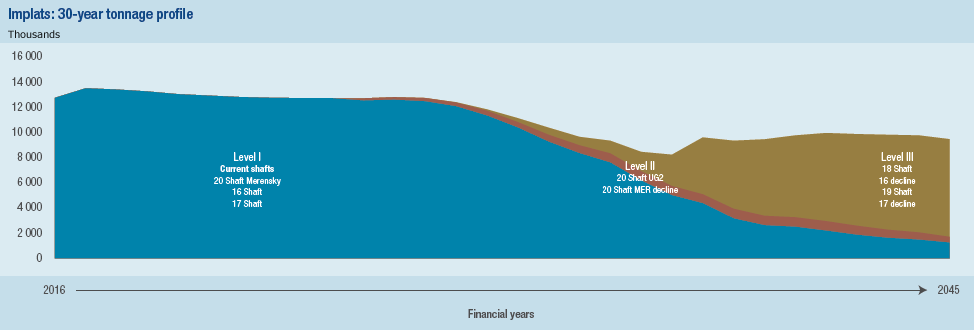
The Group will continue to prioritise key capital projects that are value enhancing in the current price environment and that are also important to long-term value creation. The priority is to complete the development of 16 and 20 shafts in line with the strategy for the Impala Lease Area. To date, some R13 billion has been invested into these projects. A further R3.9 billion in capital and off-reef capitalisation is required to complete these shaft complexes over the next three years.
Development at 17 Shaft will be further curtailed until the shaft excavations have been completed and spend on this project over the next two years will amount to R520 million. This represents an 18 month delay from the plan announced in February 2015.
Outlook
Consistent with the outcome of the strategic review announced earlier in 2015 it is critical that the Impala Lease Area be transformed. The intention is to create a more concentrated mining operation with access to new, modern shaft complexes making better use of the invested fixed cost base, with higher mining efficiencies and lower unit costs. Over the next five years the proportion of Merensky to UG2 is planned to change to 50%.
The old shafts (E/F, 4, 6, 7, 7A, 8 and 9 shafts) have been consolidated to optimise costs and realise synergies. These shafts are among the lowest-cost operations at the Impala Lease Area due to their relatively shallow mining depth and low capital requirements and will be closed timeously as they deplete. The mid-life shafts (1, 10, 11, 12 and 14) will still provide a significant base load to sustain production for the foreseeable future, but have all been adversely impacted by the challenging operating environment and low metal prices. In the current price environment both 8 Shaft and the mechanised sections of 12 Shaft are most at risk and will need to be closed by December 2015.
Given the revised capital schedule and envisaged closures, expected production from the Impala Lease Area will reduce by approximately 180 000 platinum ounces over the next five years. On this basis, production is expected to be between 815 000 and 830 000 platinum ounces by 2020.