
 Mineral resource
 Implats Annual


“Our water conservation strategy, introduced in 2011, guides our approach to water management

Water stewardship
Our management approach to water stewardship
Water is a critical input into our mining, processing and refining operations. We recognise our obligations in terms of maintaining water quality, and not compromising the access rights of other users. The strategic importance of water was further highlighted this year, with rainfall in the Rustenburg area being a third of its usual levels.
The strategy focuses on water consumption and quality management, and proposes a framework for operation-specific water conservation strategies, in line with our strategic commitment to reduce the use of potable water and increase recycled water usage. The Group’s recycled water target is 40%. We have implemented various projects to reduce potable water consumption, optimise industrial use and increase water recycling. Surface and groundwater monitoring programmes are in place, and we review our water risk assessments annually. In fulfilment of our commitment to transparency on performance, we have once again participated in the CDP Water Disclosure Project.
We engage regularly with the South African and Zimbabwean regulatory authorities in an effort to ensure that all appropriate water-use licences are in place, and that due consideration is given to our proposals for water-use amendments. At our Rustenburg operation we have continued to experience some delays in the issuing of amended licences, largely as a result of government capacity constraints. We work closely with different stakeholders to ensure security of supply for our operations and the surrounding communities.
Impala Springs are experiencing delays in receiving their amended licence. Amendment applications were submitted in 2011/2012. The Integrated Water and Waste Management Plan (IWWMP) and Rehabilitation Strategy and Implementation Plan (RSIP) are reviewed and submitted to the Department of Water and Sanitation (DWS) annually. A water balance has been developed at Impala Springs by Goldsim and is being tested. There is good control on our effluent pond levels and high recycling figures due to the operation of two crystallisers and the reverse osmosis (RO) plant.
Water management continues to receive particular focus at Impala Rustenburg. The persistently dry conditions experienced in the north-west of South Africa, together with municipal potable water supply problems, continue to present challenges to our operations and highlight the strategic long-term importance of effective water management practices. We have also been implementing a groundwater and surface-water treatment project to remediate the pollution plume around our tailings dam.
Our 2015 performance on water
This year Impala Rustenburg experienced 60% less rainfall during the summer season than the normally expected levels. The reduced rainfall impacted negatively on the operation’s water resources, such as the tailings dam return water and the Rockwall dam supplies. The extremely dry conditions also impacted negatively on water recycling levels.
Total water consumption for the Group this year was 39 701 megalitres, including both water withdrawn and water recycled. The increase of 14% on water consumption levels (2014: 34 775 megalitres) is largely attributable to the return to production this year following the termination of last year’s five-month strike, as well as the reduced rainfall levels. The maintenance in our unit consumption rate of water (megalitres per tonne ore milled) over the 2014 levels is a positive indication that we are improving our water management practices. This year, 14 325 megalitres of water was recycled, equating to 36% of all water consumed.
Further details on the total water withdrawn, consumed and recycled at each of our operations are provided in the performance table.
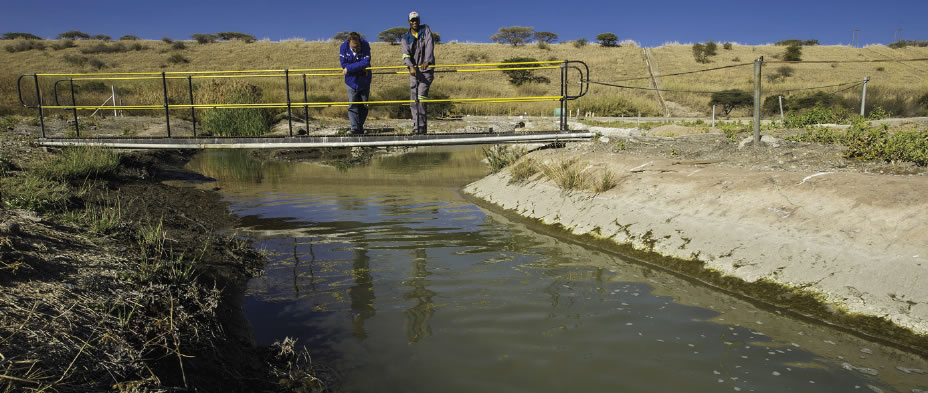
“Water is a critical input
into our mining,
processing and refining
operations
Water consumption units (Mℓ) |
2015 |
2014 |
2013 |
2012 |
2011 |
(1) Water from water service providers or municipalities |
9 576 |
7 515 |
8 851 |
10 722 |
12 636 |
(2) Waste water from other organisations |
3 104 |
2 313 |
2 598 |
2 767 |
3 769 |
(3) Water from rivers |
2 164 |
2 175 |
2 344 |
2 124 |
2 337 |
(4) Water from dams |
6 897 |
6 696 |
8 777 |
7 891 |
7 016 |
(5) Water from ground water |
3 634 |
2 667 |
2 870 |
1 770 |
1 287 |
Water withdrawn (1 + 2 + 3 + 4 + 5) |
25 376 |
21 365 |
25 440 |
25 274 |
27 045 |
Water internally recycled |
14 325 |
13 409 |
15 271 |
14 840 |
14 823 |
Total water consumption |
39 701 |
34 775 |
40 711 |
40 114 |
41 868 |
|
Notes: |
|
|
Notes 1: |
From 2011 the Zimplats and Mimosa water withdrawn from rivers and dams excludes water provided to communities (in line with the SA operations). |
|
Notes 2: |
At Marula and Zimplats, fissure water is included as groundwater from 2011. Our Zimplats operation uses a potentially significant amount of fissure water in one of its mining operations that has not as yet been quantified. |
|
Notes 3: |
From 2011 the Impala Springs water withdrawn includes domestic water (offices, stores, etc). This is in line with Group reporting. |
|
Notes 4: |
Unit consumption is in kl/tonne ore milled except for Impala Springs which is kl/tonne matte milled. |

Our water focus for 2016 and beyond
In South Africa we aim to:
- Continue efforts to increase the percentage water recycled, and to reduce the volume of water withdrawn.
- Continue to engage with local authorities and communities on water-related issues to ensure we meet regulatory and social expectations.
- Investigate the feasibility of water treatment alternatives.
- Update the Rustenburg operations water strategy and to access the options available for Water Conservation and Water Demand Management (WC/WDM).
- Increase the use of grey water sources by utilising fissure water emanating from Rustenburg operations 2, 2A and 5 Shaft into the water circuit.
- Continue with the water projects at Rustenburg operations where scavenger boreholes are drilled close to the operating tailings dam and floating wetlands constructed at the Rockwall dam.
- Continue lining the old BMR pond at Impala Springs operation by installing double lining with leak detection to ensure compliance with the WUL
In Zimbabwe we aim to:
- Achieve a 40% recycling of water for the Zimplats operations.
- Improve water accounting at Selous Metallurgical Complex (SMC), by installing water meters to account for recycled sewage effluent and storm water.
- Conduct internal water and energy audits to ensure efficient use of resources at Mimosa.