Mineral resource
 Implats Annual


“Each year we conduct
a GHG emissions
assessment to identify
areas for GHG mitigation
and increasing
efficiencies

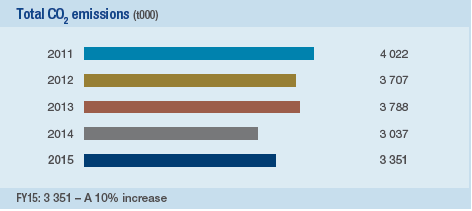
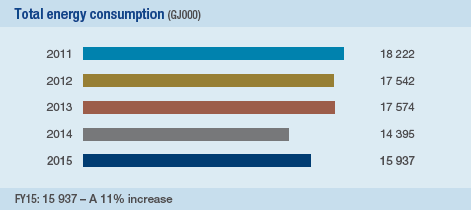
Each year we conduct a GHG emissions assessment to identify areas for mitigation and increasing efficiencies. Over the last three years we have invested over R100 million on energy conservation programmes, resulting in a reduction of 8% in indirect energy usage when compared against the year 2013. The 2014 financial year performance was impacted by the five-month strike and is thus not comparable year on year. Energy efficiency initiatives implemented across the Group are:
- The conversion of all underground lighting at Impala Rustenburg to a more energy efficient lighting source. This is estimated to reduce annual consumption by 15GWh
- The optimised use of compressed air systems at Impala Rustenburg which has achieved an estimated reduction of 7.8GWh per annum
- The underground compressed air optimisation project with an estimated future annual saving of 61.3GWh per annum
- The installation of power factor correction equipment at Rustenburg and Mimosa has resulted in an average 4% reduction in annual energy consumption
- Projects aimed at continuing to investigate opportunities for alternative lower-carbon and carbon-neutral fuel sources.
Climate change indicators |
Units |
2015 |
2014 |
2013 |
2012 |
2011 |
|
Direct CO2 emissions |
(t000) |
349 |
323 |
40 |
418 |
436 |
|
Indirect CO2 emissions |
(t000) |
3 002 |
2 714 |
3 387 |
3 289 |
3 587 |
|
Electricity purchased |
(MWh000) |
3 129 |
2 780 |
3 395 |
3 322 |
3 469 |
|
Direct energy |
(GJ000) |
4 671 |
4 386 |
5 350 |
5 584 |
5 661 |
|
Indirect energy |
(GJ000) |
11 266 |
10 008 |
12 224 |
11 958 |
12 561 |
|
Total energy |
GJ000) |
15 937 |
14 395 |
17 574 |
17 542 |
18 222 |
Case study: Managing energy security concerns
The continuing electricity supply constraints in South Africa present a significant and potentially prolonged impact on our South African operations. In its 2015 budget review National Treasury of the Republic of South Africa stated that the country will experience constrained electricity supply for at least the next two to three years.
Eskom load curtailment
As a ‘key customer’ or ‘energy-intensive user’ with Eskom, Implats has specific agreements in place with the electricity provider. In terms of a signed ‘load curtailment document’, Impala Rustenburg is given timely caution to implement load curtailment measures whenever the power system becomes severely constrained. During a stage 1 and 2 load curtailment, we are required to reduce demand by 10% within two hours of notification, under stage 3 we have to reduce demand by 20% within two hours, while stage 4 represents an unscheduled requirement to reduce demand, as instructed by the National System Operator. As a result of our on-site real time power-monitoring system, we have been able to act swiftly and accurately when required. This information also makes Impala’s efforts to assist Eskom more credible, contributing to the ongoing good relationship that we have been careful to maintain with Eskom.
Energy reduction plans have been developed and modelled for a range of Eskom scenarios, designed to minimise risks to employee safety, and ensure minimal production loss.
During the year Impala received 56 stage 1 and stage 2 load curtailment requests to reduce electrical power usage by the required 10%. The total declared emergency amounted to 514 hours. The weekend requests were and are managed by ensuring the compressors do not exceed 60MW. For early morning week-day requests, load reduction first takes place at our Mineral Processing Plant (furnaces, slag plant and milling circuits) until such time as the Impala profile falls below the calculated Eskom average demand. Afternoon requests by Eskom have not impacted production thus far and this is due to significant reduction in the Impala demand profile from early afternoon through to early evening.
Exploring self-generation initiatives
Given the current energy context we are aggressively pursuing opportunities to take Implats along the path of sourcing alternative energy supply. As part of this initiative we have been partnering with local businesses to develop and deliver fuel cell solutions that provide sustainable economic returns. The first phase of the project involves the installation of cells using phosphoric acid fuel cell technology from Fuji Electric in Japan. This will operate off excess hydrogen piped to Impala Springs for the metal reduction process. The fuel cells will supply an initial 1.8MW of power in two tranches of 900kW and will also produce heat that will be integrated into the operation. The chemical reaction by the fuel cells produces zero emissions except for clean water that can be utilised within the plant. The first electricity from this project will be available in 2016, subject to final approval and implementation of a power purchase agreement. The second phase of the project will involve the installation of a Doosan fuel cell system producing up to 20MW operating on natural gas.
Additionally, a solar powered project to deliver sufficient power alleviating stage 1 load curtailment is being considered for installation and across the fence supply of power at Impala. The project will need a vast area for installation of the solar panels, which will require the cooperation/involvement of the Royal Bafokeng (land owners).
Our carbon and energy management focus for 2016 and beyond
We have prioritised the following climate change and energy management activities for the year ahead:
- Further improving our atmospheric emissions data management systems, to ensure that we are aligned with the requirements of the national atmospheric emissions inventory system (NAEIS) in South Africa, an online national reporting platform that will hold both air pollutants and greenhouse emissions inventories.
- Updating the Group carbon footprint and setting realistic reduction targets for each operation in line with our carbon management strategy.
- Further understanding the impact of climate change on our operations and surrounding communities.
- Continue to work with government and academic institutions on the development of fuel-cell technologies that will utilise PGMs as alternative energy sources. A total of R6 million budget for this project has been spent over the last three years.
- Zimplats is targeting a 1% reduction in carbon emissions through the implementation of energy efficiency initiatives and carbon offset projects.