Mineral resource
 Implats Annual


“Ambient air quality is monitored at our operations via a network of ambient monitoring stations

Air quality management
Our management approach to air quality
The most significant air quality emission for the Group relates to the sulphur dioxide (SO2) emissions from our smelting and refining operations in Zimplats, Rustenburg and Impala Springs. In August 2014 we received the new air emission licence required for Impala Rustenburg which expires in July 2019 when new permit conditions are anticipated. Impala Springs received their air emissions licence (AEL) in February 2014 and will be up for renewal in 2018. Both Impala Rustenburg and Impala Springs are located within priority areas as promulgated by the National Environmental Management Air Quality Act. We are fully compliant with the current licence conditions in Rustenburg.
Ambient air quality is monitored at our Impala Springs and Rustenburg operations via a network of ambient monitoring stations. These monitoring stations measure SO2, NOx and particulate matter and provide an indication of ambient air quality levels and associated trends. The ambient monitoring results reflect the quality of ambient air in the region and not just around the operations. Source apportionment analysis has been conducted at the Impala Springs operations. However, it is much more difficult to accurately attribute the source of pollution at the Rustenburg operations, due to the extent of the mine lease area. Various factors influence the ambient measured data. We report on the results of the ambient monitoring to the relevant authority on a quarterly basis and as and when requested. In terms of managing our direct impacts we are operating within the conditions of our air emissions licence for both these operations.
In addition, at Impala Springs, a R250 million project to address airborne emissions from the coal-fired boilers is due for completion during the 2017 financial year. In a phased approach, this will ensure sustained compliance to NOx, SOx and particulates emissions from these operations as prescribed by both current and future limits in our air emissions licence.
At the Zimplats operations an SO2 emissions abatement bankable feasibility study was commissioned in the 2015 financial year to ensure both smelter stack point source and ground level concentrations around the Selous Metallurgical Complex communities fall within the South African legislative limits. The sizing of the acid plant required the definition of the future smelter expansion road map. A conceptual study of the smelter expansion was completed and resulted in the smelter expansion road map. Air dispersion modelling of the smelter expansion scenarios resulted in a sulphur emissions reduction plan (SERP). The SERP identified the installation of a higher stack (>200m) as a first step to ensure the ground level concentrations around the SMC communities fall within the South African 24-hour average legislative limit of 125ug/Nm3. However, point source stack emissions will not be complying with South African legislative requirements. An acid plant will then be installed in later years to ensure SO2 from smelter operations comply on both stack point source and ground level concentrations.
Our 2015 performance on air quality
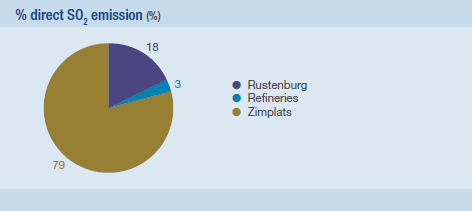
This year, total direct Group emissions of SO2 were 27 706 tonnes, down from our emissions of 30 735 tonnes in 2014. Our Zimplats operations contributed 79% of total direct SO2 emissions, while Rustenburg and Refineries operations contributed 18% and 3% respectively. Indirect SOx amounted to 26 513 tonnes and indirect NOx amounted to 13 459 tonnes. Further details on the SO2 emissions at each of our operations over the past five years are provided in the performance table.
At Zimplats, SO2 emissions decreased by 18% from the previous year, primarily due to a furnace break out incident.
As a result of the unseasonably low rainfall levels experienced in the Rustenburg area, dust has become a particular concern. We have undertaken climatic modelling around the tailings dam to model the zone of influence, and will be extending the exercise for other dust sources. We are also investigating opportunities for further improving dust suppression.
Our air quality focus 2016 and beyond
At the South African operations we aim to:
- Maintain adherence to Atmospheric Emission Licences
- Complete the coal-fired boilers emission project by end of the 2016 financial year at Impala Springs.
At the Zimbabwean operations we aim to:
- Conduct and complete the higher stack definitive study for the SO2 management plan in Zimplats.